Online training for purchasing and specification
Buying a compressor on purchase price is one of the most expensive decisions in industrial procurement.
The cheapest compressor can cost significantly more over its operating life. Learn how to identify the difference before you approve the investment.
This online course gives procurement, engineering and management teams the independent knowledge, comparison methods and practical tools needed to evaluate compressed air investments with greater confidence.
No prior compressed air expertise required.
Does this sound familiar?
A major investment is being approved without an independent basis for comparison.
A compressed air investment often begins with a supplier recommendation, an installer proposal or an existing specification. Technical figures are presented in different formats, time is limited and the final decision must often be approved by people who are not compressed air specialists.
- 01
Different suppliers present performance data in different ways
- 02
Purchase price receives more attention than operating cost
- 03
System size is based on estimates rather than measured demand
- 04
Future requirements are added without a structured calculation
- 05
Pressure, leakage and storage are considered after the purchase
- 06
The buyer has no neutral framework for challenging the proposal
The result may appear acceptable at commissioning while creating unnecessary cost for years afterwards.
The real purchasing decision
The equipment price is only one part of what the system will cost.
The financial outcome of a compressed air investment is affected by far more than the initial quotation.
Cost categories across the ownership lifecycle
Acquisition cost
Energy consumption
Maintenance
System pressure
Operating profile
Control method
Required capacity
Leakage
Storage
Future expansion
A lower purchase price does not automatically mean a lower cost over ten years.
The purpose of the training is to help the buyer compare the full operating consequence of each decision, not simply the initial quotation.
The person selling the equipment should not be your only source of purchasing knowledge.
Suppliers understand their own products. The buyer still needs an independent framework for deciding what the system requires, how proposals should be compared and which assumptions need to be challenged.
Manufacturer independent
No compressor brand, distributor or service provider influences the training content.
Focused on total cost of ownership
The course teaches comparison based on lifecycle cost, not just acquisition price.
Based on measured system requirements
Specification should start from what the system actually needs, not what is easiest to sell.
Designed to support technically neutral comparison
Participants learn to compare proposals on a consistent, defensible technical basis.
The course content is informed by four decades of specialist experience and more than 12,000 compressed air optimisation projects.
Who is this course for?
For anyone responsible for a compressed air investment.
Procurement and purchasing
For professionals responsible for capital equipment and supplier evaluation.
Project and process engineering
For those specifying system requirements and reviewing technical proposals.
Plant and technical management
For managers comparing performance, configuration and operational consequences.
Operations and finance
For leaders approving the investment and its long term financial impact.
Energy management
For professionals who want operating cost and energy performance considered before purchase.
No prior compressed air expertise is required. The course begins with the fundamentals and builds systematically towards the technical confidence needed to manage a major procurement.
Professional online course
Professional Guide to Purchasing Compressors
A structured online course for professionals who need to specify, evaluate or approve a compressed air investment without relying entirely on supplier recommendations.
- Format
- Professional online course
- Pace
- Self paced
- Modules
- 13 modules
- Duration
- Approximately 2–3 weeks
- Video
- Video content
- Handbook
- Written handbook
- Tools
- Practical tools and templates
- Assessment
- Short knowledge checks
What the course covers
Each module combines specialist video instruction, written material, practical resources and a short knowledge check.
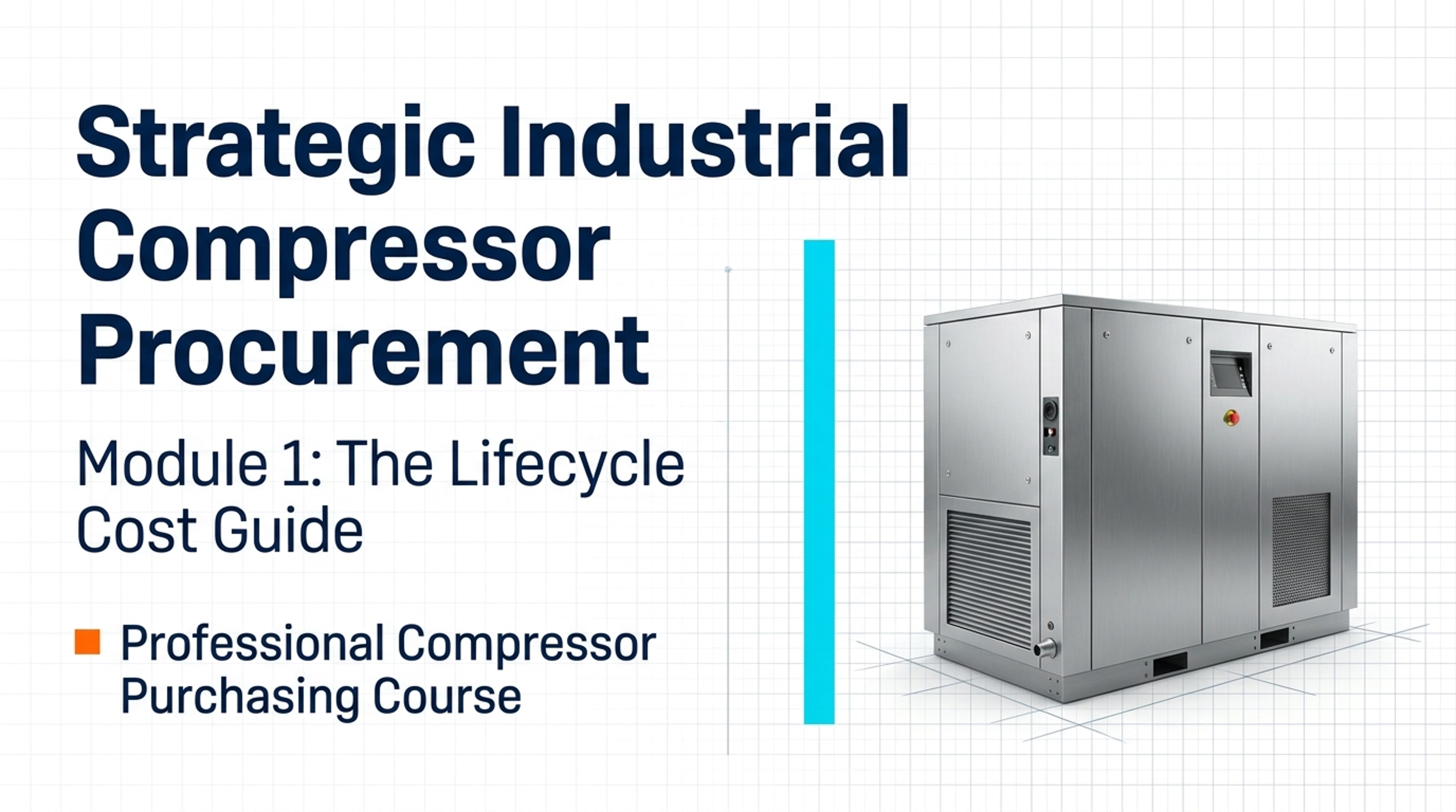
Introduces the course objectives, the difference between purchase price and total cost of ownership, and the most common compressor purchasing mistakes.
- Course objectives and expected outcomes
- The seven most common purchasing mistakes
- Real-world case studies and their financial impact
- Total cost of ownership versus purchase price
Tools you can use in your next procurement
Demand Side Control and Storage supplementary module
Understand how demand side control and storage affect system sizing and purchasing decisions.
ModuleStorage Sizing Calculator
A working spreadsheet tool for calculating receiver and storage requirements from real demand data.
ExcelFull compressor RFQ template
A technically neutral request for quotation template that supports meaningful supplier comparison.
TemplateCAGI data sheet interpretation guide
Learn to read, compare and rebase CAGI data sheet performance figures across suppliers.
GuideWritten course handbook
A complete reference document covering the full course material in written form.
HandbookPractical templates
Ready to use templates for specification, comparison and evaluation tasks.
TemplatesKnowledge checks
Short checks at the end of each module to confirm understanding before moving on.
Assessment
The course is designed to leave the participant with working procurement tools, not only theoretical knowledge.
What you will learn
The confidence and tools to challenge a proposal constructively.
Speak the supplier's technical language
Have an equal conversation with a compressor supplier using the correct terminology and performance figures.
Build a working TCO model
Create a Total Cost of Ownership model for a future specification, not just a purchase comparison.
Issue a technically neutral RFQ
Use a request for quotation template that supports meaningful, like-for-like supplier comparison.
Read and rebase CAGI and ISO 1217 data
Interpret CAGI data sheets and ISO 1217 performance figures, and rebase them for fair comparison.
Apply a pre-purchase optimisation checklist
Cover leakage, pressure and demand side considerations before the purchasing decision is finalised.
Challenge assumptions on a credible basis
Question supplier proposals using a defensible technical basis rather than instinct or price alone.
Can the course pay for itself?
The course addresses practical sources of avoidable cost, including leakage, overpressure, poor specification and unnecessary running cost. A single improved specification decision, pressure adjustment or leakage action may be worth significantly more than the course fee.
Actual results depend on the organisation, system, implementation and operating conditions. The course does not guarantee a specific financial saving.
See how the course works before you enrol
Preview a selected module and experience the structure, level and practical approach of the training.
Each module is introduced by the practitioner responsible for the course content. The focus is on why the knowledge matters, how purchasing decisions affect the operating system and how the tools can be applied in practice.
Further module previews will be available through a free account.
Already operating the system you have?
Purchasing decisions shape future performance, but existing systems may also contain leakage, pressure and demand side inefficiencies.
Optional related programme: Leakage Management Programme
Support beyond the course
Need help choosing the right training or team access?
Contact Daniel and the LMS Nordic team for guidance on course selection, team access or your organisation's training needs.
Prepare for your next compressed air investment with confidence.
Build the independent knowledge needed to evaluate equipment, specifications and lifecycle cost before the purchasing decision is made.